From Mainframe to SmartPhone
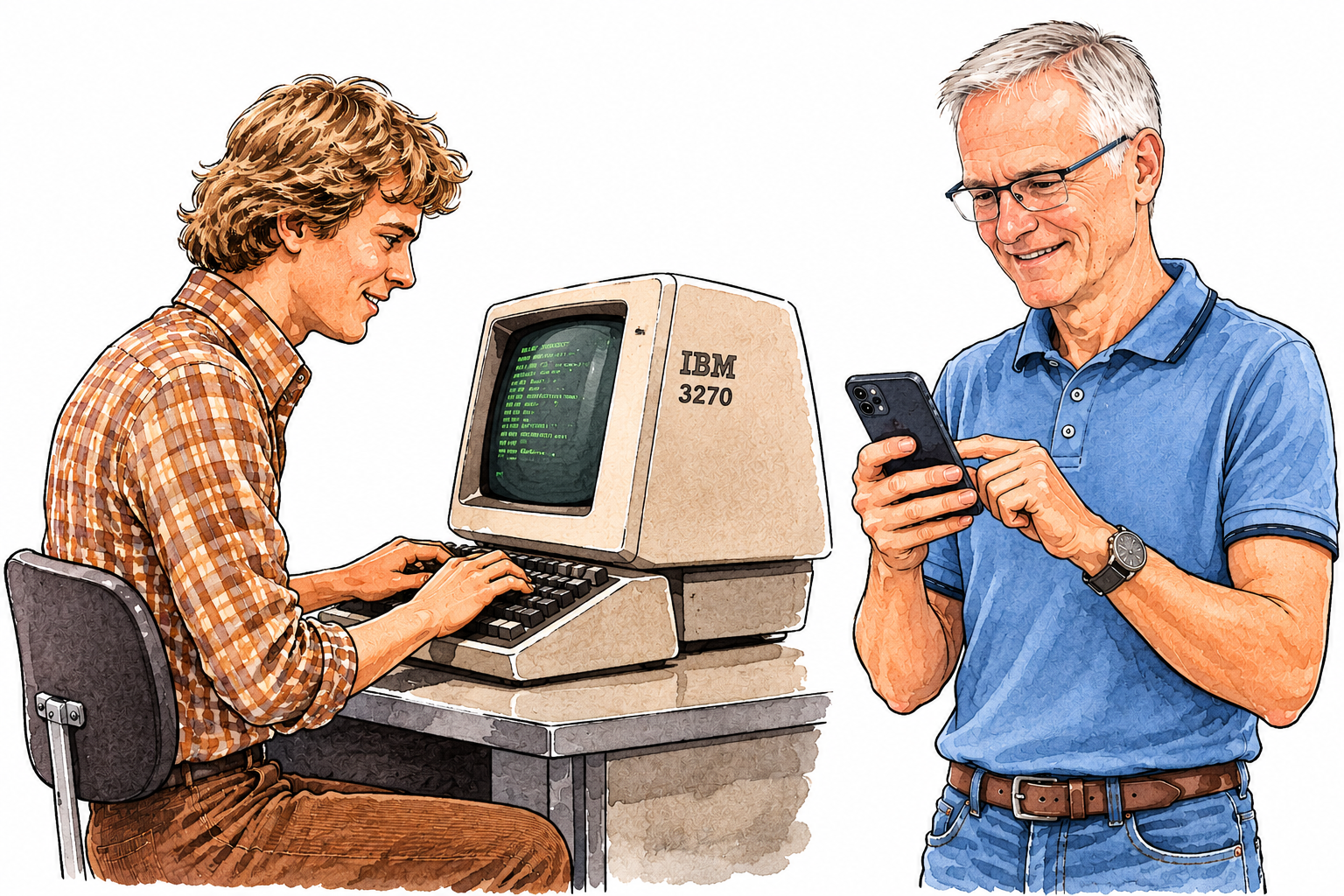
When I first started I worked on an IBM 370 Mainframe with MVS. On physical punchcards, a year later I was one of the first that was able to use a terminal to directly input and test my code.
Computers (mainframes) were heavy, big in physical size and astonishingly expensive.
To illustrate that I created the below program to compare an 1978 mainframe to a recent smartphone. Then you will understand why my first programs in assembler had to fit into 20k.....
Choose your Phone & See the 1978 Shock
Select one of the modern smartphones below. Witness instantly what kind of massive 1978 infrastructure—measured in football fields and Dutch households—was hiding in your pocket.
Football Fields of Mainframes
Replicating storage and compute power using 1978 hardware.
Dutch Households Equivalent
Continuous megawatt power required in 1978.
🔍 Methodology & A Fun Wink to the Past
How seriously should you take this? Well, with a strong cup of black coffee and a big smile! We mapped modern chip specs to the raw performance of IBM’s legendary 3033 mainframe and 3350 disks from 1978. Obviously, a 1978 mainframe couldn’t stream mobile games, but purely in terms of bits, bytes, and raw MIPS processing capability, the numbers are mind-boggling.
The calculation also factors in mandatory 1978 cooling plus raised-floor facility overhead. Long story short: we are extremely glad we carry this power in our pockets today instead of dragging a power plant behind us!